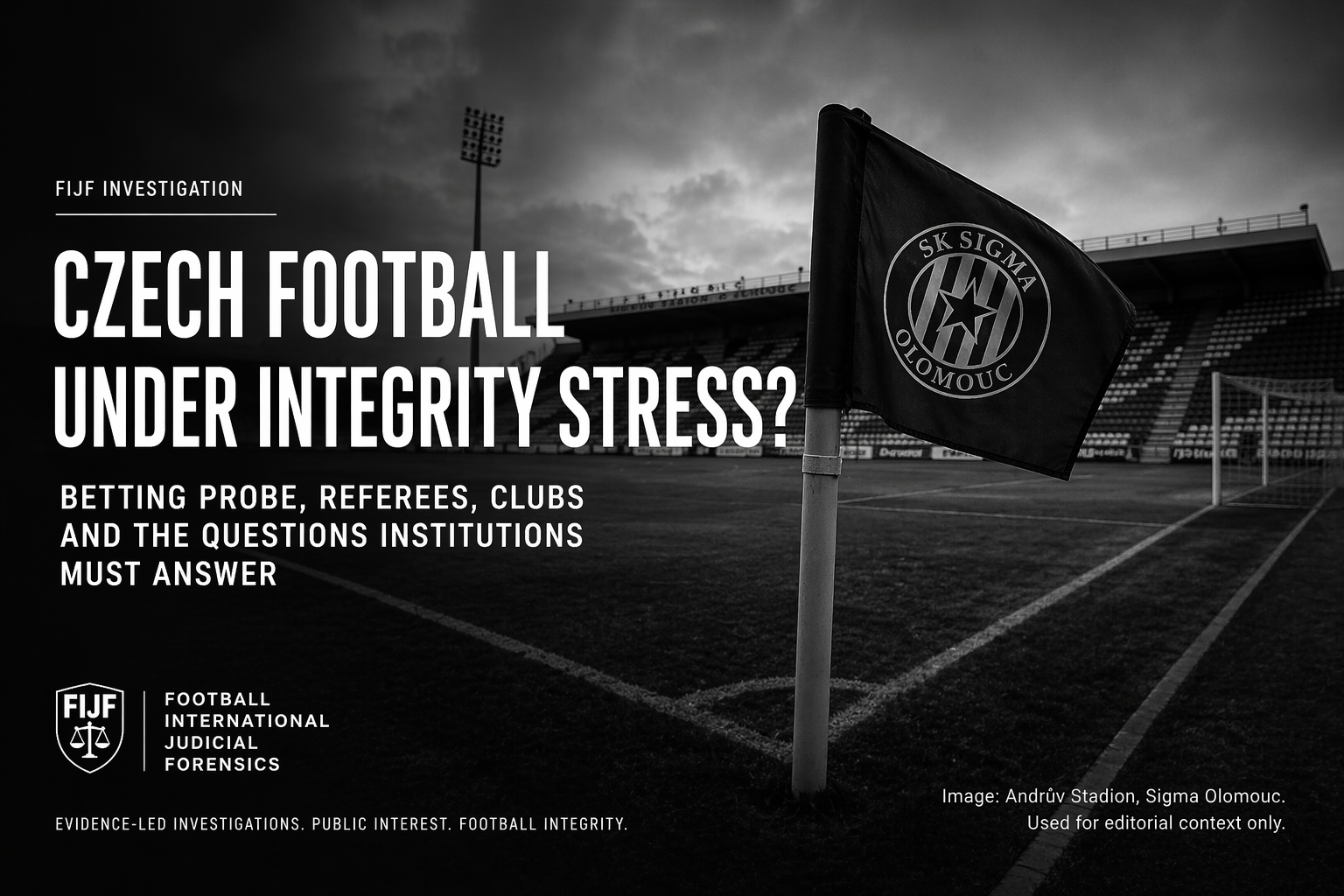
Czech Football Under Integrity Stress?
Betting probe, referees, clubs and the questions institutions must answer.
Legal note: FIJF does not accuse any individual, club, referee, official, federation employee, intermediary, or institution of wrongdoing. This dossier summarizes public reporting, official disciplinary references, and police or prosecutorial statements available at the time of publication. All individuals and entities are presumed innocent unless proven guilty by a final court decision.
FIJF watchdog position: FIJF is a public-interest watchdog. We collect public and open-source information, document patterns, preserve the presumption of innocence, and ask questions that football institutions should be able to answer. Where information becomes solid, verifiable, and relevant to possible misconduct, FIJF may submit material to competent authorities, including police, prosecutors, regulators, federations, integrity units, or other investigative bodies.
Case status: developing. Czech reporting states that police charged 32 people in a football betting and corruption case, while FAČR’s Ethics Commission opened disciplinary proceedings involving clubs, players, referees and officials. FIJF will update this page if official decisions, court rulings, corrections, or right-of-reply submissions become available.
Table of Contents
- Introduction — A Czech case that now has names
- The official scale: 32 charged, 47 disciplinary proceedings
- Clubs named in public reporting
- MFK Karviná, Jan Wolf and the reported allegations
- Samuel Šigut, Matěj Hýbl and player vulnerability
- Referees named in reporting
- Pavel Býma, FC Zlínsko and custody decisions
- Jakub Prokeš and the intermediary layer
- Jakub Elbel: named in reporting, not charged according to reports
- Betting markets: corners, fouls and micro-events
- European comparison: why this pattern matters
- FIJF public-interest questions
- FIJF recommendations
- Sources reviewed
Introduction — A Czech case that now has names
Czech football is facing one of its most serious modern integrity crises. Public reporting from Czech outlets states that police charged 32 people in connection with a betting and corruption case. Separately, Czech reporting states that FAČR’s Ethics Commission opened 47 disciplinary proceedings involving clubs, players, officials and referees.
This is no longer a vague “football corruption” story. Reporting has named clubs including MFK Karviná, SFC Opava, FC Zlínsko, 1. SC Znojmo, TJ Start Brno and FC Vratimov. Public reports also name players, referees, officials and intermediary figures.
FIJF’s question is deliberately narrow and legally disciplined: is this only a criminal case involving individuals, or does it expose deeper weaknesses in Czech football’s integrity architecture?
Integrity does not begin when guilt is proven. Integrity begins when institutions can show that their systems were designed to prevent manipulation before a scandal becomes public.
Submit confidential information
1. The official scale: 32 charged, 47 disciplinary proceedings
Seznam Zprávy reported that police charged 32 people in connection with the football corruption and betting case. The reporting describes allegations including participation in an organized criminal group, fraud, bribery and money laundering. Prosecutorial statements cited in Czech reporting also indicated that the number of accused may not be final.
Separately, Czech media reported that FAČR’s Ethics Commission opened 47 disciplinary proceedings. TN.cz published a list of clubs and individuals connected to those proceedings, including active players, referees, officials and clubs.
The number matters. One isolated approach to one player would already be serious. A case producing dozens of police charges and dozens of disciplinary proceedings raises a broader institutional question: how does a football ecosystem detect, contain and explain integrity risk before trust collapses?
- Were football authorities detecting risk proactively, or following evidence gathered by police?
- How long had suspicious patterns existed before formal action became public?
- What role did FAČR’s internal integrity mechanisms play before police intervention?
- Will the final lessons be published, or will the system move on after individual sanctions?
2. Clubs named in public reporting
Public reporting identifies the following clubs among those connected to FAČR Ethics Commission disciplinary proceedings:
- MFK Karviná a.s.
- Slezský FC Opava a.s.
- FC Zlínsko
- 1. SC Znojmo
- TJ Start Brno
- FC Vratimov
MFK Karviná is the most prominent name because it is a top-flight club and because Czech reporting links the case to alleged attempts around the March 2024 match between MFK Karviná and SK Dynamo České Budějovice. Reporting also refers to the later relegation-playoff context involving MFK Karviná and MFK Vyškov.
FIJF does not conclude that any club gained sporting advantage. The institutional question is different: when a top-flight club appears in public disciplinary material, what temporary safeguards should a league apply while proceedings continue?
- Should clubs under disciplinary review face temporary integrity supervision?
- Should match appointments involving affected clubs receive additional independent review?
- Should the league publish an anonymised risk protocol for clubs appearing in integrity investigations?
3. MFK Karviná, Jan Wolf and the reported allegations
One of the central public names is Jan Wolf, mayor of Karviná and a figure connected with MFK Karviná. Seznam Zprávy reported that FAČR documents suspected Wolf of involvement in attempts to influence the March 2024 match between Karviná and České Budějovice.
Czech reporting states that alleged offers involved referee Jan Všetečka and video referee Miroslav Zelinka. Other reporting discussed alleged match contexts involving Karviná’s survival fight and the later playoff against Vyškov. Wolf has publicly rejected allegations reported in Czech media and remains presumed innocent.
This matters because the case is not only about betting. It raises a governance question: what happens when a political office-holder, a club-linked figure and a football integrity case appear in the same public record?
- Was the alleged conduct individual, or does it expose structural conflicts between politics, club governance and sporting survival?
- Should Czech football require stricter conflict-of-interest declarations for club-linked municipal figures?
- When public office and football authority overlap, who audits the boundary?
- Should a first-division club connected to public allegations publish an internal integrity statement?
4. Samuel Šigut, Matěj Hýbl and player vulnerability
Samuel Šigut appears repeatedly in Czech reporting. Reports state that investigators allege he was approached in relation to the Karviná–České Budějovice match context. Czech reporting also names Matěj Hýbl among football figures connected to disciplinary proceedings.
FIJF does not state that either player committed wrongdoing. That is for competent authorities and courts. The public-interest issue is different: if players are allegedly approached before survival-critical matches, what protection and reporting systems exist?
Across Europe, football integrity cases often expose the same pressure points: unstable contracts, pressure from sporting survival, lower salaries outside elite clubs, and informal networks around players. Even where individual guilt is not proven, the system still has to answer whether its preventive safeguards were strong enough.
- Could players in financially or competitively unstable environments be more vulnerable to pressure?
- Do clubs run real integrity training, or only formal compliance presentations?
- Are players given anonymous, protected channels to report suspicious approaches?
- Should clubs receive mandatory integrity alerts when players are named in external investigations?
5. Referees named in reporting
Czech reporting names several referees in connection with disciplinary proceedings or case materials, including Jan Všetečka, Miroslav Zelinka, Jan Petřík, Josef Tomanec, Simon Vejtasa, Jan Nápravník, Luboš Drozdy, Michal Gasnárek, Tomáš Svoboda and Vlastimil Ogrodník.
Whenever betting concerns intersect with refereeing, the integrity question expands beyond individual conduct. It becomes a question of appointment architecture, conflict screening, VAR assignment rules and real-time risk alerts.
Referee governance is not only about whether a referee made a correct decision. It is about whether the public can understand why particular officials were selected for particular matches, how conflicts are screened, and whether sensitive fixtures receive additional integrity protection.
- Were referee appointments in sensitive matches reviewed after the case emerged?
- Did integrity alerts exist before the match, during the match, or only after later investigation?
- Should referee appointment systems integrate betting-risk data before high-stakes fixtures?
- Should VAR appointments be treated with the same sensitivity as on-field referee appointments?
6. Pavel Býma, FC Zlínsko and custody decisions
Seznam Zprávy reported that Pavel Býma, a former FC Zlínsko official and former referee, was among those brought before court. Czech reporting stated that some accused persons were placed in custody during early proceedings, while later reports indicated that certain custody reasons changed and some accused were released while the investigation continued.
FIJF stresses the distinction between custody, accusation and guilt. Custody is a procedural measure. It is not a conviction. Release from custody is also not a declaration that all suspicion has disappeared. The public often misunderstands this distinction, and football institutions should explain it carefully.
- Does custody in early proceedings indicate investigative risk, or procedural caution?
- How should the public understand release from custody while an investigation remains active?
- Are lower-division clubs sufficiently protected against manipulation networks?
- Should disciplinary bodies publish plain-language explanations of procedural status?
7. Jakub Prokeš and the intermediary layer
Czech reporting also names Jakub Prokeš, described in media as connected to TJ Start Brno and agency activity. Reports link him to allegations involving football manipulation and betting-related offences.
Intermediary figures are a repeated feature in football integrity cases across Europe. They can operate between players, clubs, betting interests and informal networks. Often they are not the most visible actors, but they may be the most important connectors.
Football governance often focuses on clubs, players and referees. Yet the vulnerable space may sit between them: agents, fixers, informal advisers, lower-division brokers and people with access but without institutional accountability.
- Do intermediary figures form the connective tissue between betting interests, players and club-linked actors?
- Are agents, managers and third-party operators monitored with the same intensity as players and referees?
- Could football’s real vulnerability sit between official club structures and informal networks around clubs?
- Should FAČR maintain a stricter registry of intermediary access in integrity-sensitive contexts?
8. Jakub Elbel: named in reporting, not charged according to reports
A key example of legal caution is Jakub Elbel, defender of Sigma Olomouc. Seznam Zprávy reported that Elbel was not accused by police and that FAČR’s Ethics Commission had not opened proceedings against him, while also reporting that police documents mentioned him in connection with alleged knowledge or communication. Elbel denied wrongdoing in that reporting.
FIJF does not call him guilty. FIJF does not call him accused. FIJF states only what public reporting says: he was named in reporting based on police material, denied wrongdoing, and was not charged according to that report.
This distinction matters. Investigative reporting must not erase the difference between being named in a file, being questioned, being accused, being charged, being disciplined, and being convicted. Each status carries different legal and reputational weight.
- How should football protect individuals named in investigative files but not charged?
- Should clubs comment when police documents mention a player but no formal proceeding exists?
- What threshold should trigger internal review without damaging presumption of innocence?
- How can media reporting remain transparent without turning suspicion into punishment?
9. Betting markets: not only results, but corners, fouls and micro-events
Czech reporting states that investigators examined not only final results but also specific match events, including corners, fouls, cards and related betting markets. This is critical. Modern match manipulation does not always require fixing a final score. It may target micro-events invisible to casual viewers.
A final score is hard to control. A corner, foul, card, offside, throw-in, deliberate fall, tactical delay or single phase of play may be easier to manipulate and easier to disguise as ordinary football randomness. This is why spot-fixing can become harder to detect than classic match-fixing.
For supporters, this is devastating. Once micro-events become suspect, every small moment becomes suspicious. A late card is no longer just frustration. A strange corner is no longer just poor defending. A missed challenge is no longer only technical failure. Trust collapses not because every event is corrupt, but because the public no longer knows which events are clean.
- Are lower divisions equipped to detect spot-fixing?
- Do Czech football authorities receive real-time data from betting integrity monitors?
- Are referees, players and coaches trained to understand that corners, cards and fouls can be manipulation targets?
- Are foreign betting markets monitored with the same urgency as domestic licensed markets?
10. European comparison: why this pattern matters
The Czech case does not exist in isolation. European football has repeatedly faced integrity crises involving referees, betting, lower divisions, club officials and informal networks. Italy’s Calciopoli exposed referee-governance vulnerabilities. Turkey’s recent betting crisis raised questions about betting exposure inside officiating and player structures. Other leagues have faced spot-fixing cases involving lower-tier players and micro-event markets.
The details change. The pattern often returns:
- financially vulnerable players;
- lower divisions with weaker monitoring;
- referee appointment opacity;
- informal intermediaries;
- betting markets that reward micro-event manipulation;
- federations reacting after police intervention rather than before scandal.
FIJF’s position is that integrity cases should not be treated as national embarrassments to be buried. They should be treated as laboratories for reform. If Czech football handles this transparently, it can strengthen trust. If it handles it defensively, suspicion will become institutional memory.
11. FIJF public-interest questions
- Which matches are officially under review, and which remain only media-reported?
- What did FAČR know before the police operation, and when?
- Why were 47 disciplinary proceedings opened so quickly?
- How many proceedings involve active players versus former players, officials or intermediaries?
- Were referees in sensitive matches assigned under additional risk-screening?
- Did betting operators flag suspicious patterns before police intervention?
- What role did foreign betting markets play?
- Did any club gain sporting advantage, or are the suspicions limited to attempted manipulation?
- How should Czech football protect individuals named in files but not convicted?
- Should clubs in disciplinary proceedings face temporary integrity supervision?
- Will FAČR publish anonymised lessons after the case, or only final punishments?
- Can Czech football prove that its integrity safeguards are preventive, not only reactive?
12. FIJF recommendations
FIJF does not legislate, prosecute or discipline. But public-interest scrutiny allows us to propose safeguards that reduce future manipulation risk.
1. Independent appointment audit
Sensitive match appointments should be independently reviewable, especially where betting-risk alerts, relegation stakes or disciplinary concerns are present.
2. Real-time betting alert integration
Federations should integrate betting-monitoring alerts directly into matchday integrity systems, not treat them as separate technical data.
3. Lower-division protection
Lower divisions often carry the highest manipulation risk. Integrity resources should not be concentrated only at elite level.
4. Intermediary registry and monitoring
Agents, former officials, informal brokers and third-party operators should be part of integrity-risk mapping when they operate near clubs or players.
5. Protected reporting channels
Players, referees and club staff must have protected, confidential channels to report suspicious approaches without fear of retaliation.
6. Public integrity reporting
FAČR should consider an annual anonymised integrity report explaining alerts, conflicts, training, disciplinary lessons and structural reforms.
Conclusion — An integrity stress test
The Czech betting and corruption case is no longer abstract. Public reporting has named clubs, players, referees, officials and alleged match contexts. Police have charged 32 people. FAČR’s Ethics Commission has opened disciplinary proceedings. Several individuals deny wrongdoing. The legal process continues.
FIJF’s position is clear:
We do not accuse. We do not convict. We do not replace courts.
But we will keep asking the question football often avoids: if the system is clean and resilient, can it prove that through transparency, documentation and reform?
Submit information securely:
Anyone with verifiable information, documents, screenshots, contracts, betting records, internal correspondence,
match materials, or first-hand knowledge can contact FIJF at:
tips@fijf.org
Sources reviewed
- Seznam Zprávy — police charges, 32 accused, Jan Wolf and FAČR materials.
- Seznam Zprávy — reporting on alleged Karviná, České Budějovice and Vyškov match contexts.
- TN.cz — FAČR Ethics Commission list of proceedings, clubs, players and referees.
- iROZHLAS / Radiožurnál — wider Czech betting-mafia and football-integrity coverage.
- TN.cz — overview of the Czech football corruption scandal and background context.
- Seznam Zprávy — reporting on alleged betting-mafia mechanisms and case anatomy.
- Seznam Zprávy — reporting on police material and alleged “penalty” instruction context.
- Reuters / international summaries — overview of Czech police operation and football association response.